On 26 March 2026, the European Parliament approved a substantial legislative amendment to update and strengthen the recovery and resolution rules for the banking sector that the EU put in place after the Global Financial Crisis (GFC) of 2008. The rules govern how banks in the EU are to be managed when they fail or are at risk of failing. They set out how losses are to be allocated and depositors protected, and enable resolution authorities to intervene in an orderly way. The new Crisis Management and Deposit Insurance (CMDI) package revises those rules to address structural weaknesses that have become apparent over the past decade of implementation, including the unavailability of the resolution framework for smaller and medium-sized banks.
Political process
The Commission reviewed the EU crisis management framework through an evaluation process, stakeholder consultations, technical input from the EBA and an impact assessment, before publishing its reform proposals in April 2023.
During the legislative process, negotiations centred on three closely linked issues:
- The reform of the public interest assessment: The Commission, supported by the Parliament, sought to facilitate the use of resolution for smaller and medium-sized banks. The Council favoured a more cautious standard that preserved greater national discretion.
- The conditions for deploying the Deposit Guarantee Scheme (DGS) funds outside of the standard depositor payout: While the Commission and Parliament favoured broader access to DGS resources to facilitate the use of resolution, particularly for smaller and medium-sized banks, the Council insisted on stricter conditions and safeguards.
- The ranking of depositors in insolvency: To facilitate the use of DGS funds in resolution, the Commission proposed a single-tier depositor preference regime. The Parliament favoured a two-tier approach, and the Council wanted to preserve the existing three-tier hierarchy.
The final text of the CMDI package was published in the Official Journal on 20 April 2026. It amends the Bank Recovery and Resolution Directive (BRRD), the Single Resolution Mechanism Regulation (SRMR) and the Deposit Guarantee Schemes Directive (DGSD). The three instruments apply from different dates, but the core reforms must be transposed by member states by 11 May 2028.
In this article, we first discuss the lessons learned from recent banking crises and the broader developments that prompted the CMDI reforms. We then look at the measures intended to broaden access to resolution and to strengthen resolution financing, and at the reforms relating to depositor protection and creditor hierarchy. Finally, we address the package's broader simplification measures and conclude with the key takeaways for financial institutions.
In this article, we focus on the key themes, reforms and practical implications of the CMDI package for financial institutions, but do not aim to provide an exhaustive overview of every amendment.
Lessons learned after a decade of CMDI
The CMDI reform cannot be seen separately from the 2023 banking turmoil, which represented the most material test of the regulatory framework since its introduction. The current global standards for recovery and resolution were developed in response to the GFC, when many institutions were labelled too big to fail and saved from insolvency through publicly funded bailouts. In the aftermath, policymakers sought to reduce this exposure by shifting the standard from bail-out to bail-in. In the European Union, this resulted in the adoption of the BRRD and the broader CMDI framework.
However, the failures of Silicon Valley Bank (SVB), Signature Bank and First Republic Bank in the United States, as well as Credit Suisse – a global systemically important bank – in Switzerland, revealed several shortcomings in the framework. This prompted regulators locally, but also globally, to reassess if existing crisis-management and resolution frameworks could respond to modern banking crises effectively.
Among these failures, different underlying causes can be discerned, with varying crisis-management responses and resolution measures applied. Nevertheless, certain recurring themes and issues can be identified.
SVB had a highly concentrated depositor base with a relatively small number of depositors, with over 95% of accounts exceeding the amount covered by the US deposit insurance system. These deposits were invested in interest rate-sensitive securities and held-to-maturity investments, making the bank particularly vulnerable in distressed scenarios. A rapid run off in deposits, a failed attempt to raise capital and fears of a bank run rapidly spreading via social media contributed to SVB's eventual failure.
With digital banking channels and social media, deposit withdrawals accelerated at a pace not previously experienced. In response, the Federal Reserve, the Treasury and FDIC jointly invoked a "systemic risk exception" to guarantee all deposits held at SVB, including uninsured amounts above USD 250,000. In addition, SVB was able to alleviate acute liquidity concerns as it could draw under the Federal Reserve's newly established Bank Term Funding Program against favourable conditions – specifically, permitting the valuation of collateral at par rather than market value. After a competitive bidding process, what was left of SVB – contained in an FDIC-operated bridge bank – was eventually sold to First-Citizens Bank & Trust Company.
The demise of Credit Suisse had its root cause in a combination of longer standing weaknesses in governance, risk management and business strategy. It ultimately also suffered from a severe loss of market confidence after the announcement that "material weaknesses" had been found in its financial reporting – again, exacerbated by digital communication channels.
By mid-March 2023, when liquidity outflows rapidly increased due to the digital banking run, the Swiss National Bank, FINMA and the Federal Council brokered an emergency merger with UBS. Even though alternative measures had been prepared, including a restructuring of the bank, it was decided that the takeover by UBS provided the fastest and lowest risk solution. The Swiss authorities accommodated the sale, among other things by providing a large emergency liquidity package and a loss protection agreement for designated portfolios acquired by UBS.
The bank failures of 2023 made two things very clear. First, that the protection of deposits, including non-covered deposits, is an important driver of resolution actions. Second, the crises brought to light the need for flexibility and freedom, on the authorities' side, to pick from alternative resolution strategies depending on what circumstances require.
However, these measures also cast doubt on the practical use of the resolution regime. If the preferred response to distress is the sale of the institution, the purpose of extensive resolution planning becomes less apparent. Against this backdrop, legislators shifted their focus towards enhancing operational preparedness and flexibility to consider alternative resolution strategies.
In the aftermath of the Credit Suisse rescue, the European Central Bank (ECB) and Single Resolution Board highlighted the 2023 bank failures as an opportunity – and incentive – to review and improve the CMDI framework. In the review, they focused on elements that are reflective of the 2023 challenges as described above, namely (i) providing for flexibility and increasing available options for authorities in bank crisis management; (ii) providing a broader set of crisis management tools for small and medium-sized banks; and (iii) allowing for easier access to resolution funding. The ECB underscored that the review should aim to ensure operational continuity, protect depositors and minimise the destruction of value.
A more pragmatic approach to resolution accessibility and financing
Experiences with banking crises since the GFC exposed weaknesses in the resolution framework. Much of the framework focused on the largest banks – those considered "too big to fail". It also sought to ensure the possibility of a bail-in, with sufficient loss-absorbing own funds and eligible liabilities being available to be converted and written down, rather than a bail-out with taxpayers' money. With BRRD, the minimum requirement for own funds and eligible liabilities (MREL) was introduced, requiring banks to maintain sufficient own funds and liabilities to recapitalise a bank through bail-in.
The availability of sufficient loss-absorbing capital also determines institutions' access to resolution financing arrangements, at national level or through the Single Resolution Fund (SRF), pursuant to amended Article 44(5) BRRD and amended Article 27(7) SRMR, respectively. Such access is currently available only when losses amounting to at least 8% of total liabilities and own funds have been absorbed by shareholders or holders of other ownership instruments, holders of capital instruments and other bail-inable liabilities.
The revision of CMDI reflects a regulatory shift. Increasingly, authorities are focusing not merely on whether a bank has sufficient loss-absorbing capacity on paper, but also on whether it could realistically maintain access to funding and liquidity throughout a resolution process, including, where needed, to ensure an orderly exit. The underlying problem is that smaller deposit-funded banks often have relatively limited amounts of loss-absorbing liabilities to meet the 8% bail-in requirement needed to access the national arrangements or the SRF. Being relatively reliant on deposit-funding, reaching that threshold would frequently require losses being passed on to depositors, something resolution authorities have generally tried to avoid – as the SVB case also demonstrated. This resulted in a complex, fragmented approach to resolution, with substantial differences in measures taken between member states, including the application of a variety of resolution tools.
Therefore, the CMDI package introduces a "bridge the gap" mechanism to help meet the 8% threshold and enable the execution of banks' resolution strategies. In addition, the introduction of a revised public interest assessment broadens access to resolution for institutions not otherwise in scope.
New rules
Expanded use of DGS funds
A significant change is the expansion of the permitted uses of DGS funds beyond the payout of covered depositors under amended Article 11 DGSD. DGS funds may now also be used to finance a transfer strategy in resolution, such as for the sale of business or the bridge institution tool. Subject to the conditions laid down in amended Article 109 BRRD, including the requirement that the total value of the assets of the institution under resolution on an individual basis does not exceed EUR 80 billion, the DGS contribution may count towards the 8% threshold needed to access the SRF. This allows that threshold to be met without imposing losses on depositors. In addition, DGS funds may be used for preventive measures taken before the determination that an institution is failing or likely to fail (FOLTF). Such preventive measures include capital support, guarantees, or loans to a credit institution in financial difficulty. Finally, DGS funds may be used to facilitate the transfer of deposits and assets to another institution outside formal resolution proceedings.
All three categories are subject to a harmonised least-cost test: the amount of the DGS intervention must not exceed the lower of the total amount of covered deposits at the institution or the amount determined by the conditions that apply to the relevant measure. In addition, where DGS funds are used to support a transfer strategy, the DGS contribution may not exceed 62.5% of the DGS's target level, unless the designated authority disapplies that limit to avoid adverse effects on financial stability or to preserve the access of depositors to their deposits. The DGS may not be used to transfer own funds instruments or liabilities ranking below ordinary unsecured claims.
The final framework largely follows the Council's position by subjecting the use of DGS funds to stricter conditions and safeguards than originally proposed by the Commission.
Revised public interest assessment
The conditions for triggering formal resolution are also adjusted under amended Article 32 BRRD and amended Article 18 SRMR. The revised framework provides that resolution is not in the public interest only if none of the resolution objectives would be at risk in normal insolvency proceedings. Where at least one objective is at risk, resolution is in the public interest – provided it is necessary and proportionate to achieve that objective – unless winding up under normal insolvency proceedings would meet those objectives more effectively. This raises the bar for concluding that resolution is not in the public interest and is intended to bring more smaller and medium-sized institutions within the scope of formal resolution proceedings.
The final wording reflects a compromise between the Commission's broader approach and the Council's preference for preserving national discretion.
Practical implications
The revised framework is intended to make formal resolution available to a wider range of institutions and expands the role of DGS funds in crisis management. Financial institutions may therefore wish to consider the following practical implications:
- Smaller and medium-sized deposit-funded banks are more likely to fall within the scope of formal resolution under the revised framework, which may make resolution preparedness relevant to institutions that have not previously invested in it.
- Where member states opt to permit their DGS to use funds for preventive measures, that DGS preventive framework is available to institutions under financial stress as an alternative to more disruptive proceedings, subject to the applicable conditions and competent authority involvement.
- For institutions active in acquiring or absorbing distressed banks, the expanded DGS toolkit is likely to increase the number of transfer opportunities, through DGS-funded transfer strategies.
- The broader use of DGS funds across more scenarios is likely to affect the overall level of contributions from member institutions, which may be relevant to funding cost calculations.
Depositor protection and confidence
The CMDI package represents a step towards completion of the Banking Union. While the European Deposit Insurance Scheme – the common fund for deposit protection conceived as the third pillar of the Banking Union – has yet to be established, the package nonetheless advances the Banking Union agenda by further harmonising national depositor guarantee frameworks and strengthening depositor protection across member states.
One of the main reasons for the CMDI package reforms is the fragmentation that has persisted in depositor protection across the EU since the introduction of the original 2014 framework. By 2023, 8 member states had introduced some form of depositor preference in insolvency, while in 19 member states, including in the Netherlands, deposits ranked on equal footing with ordinary unsecured creditors. As a result, creditors in different member states faced varying outcomes in the event of a bank failure, creating an uneven playing field across the EU.
The lack of a harmonised creditor hierarchy also complicated the use of the bail-in tool. In practice, deposits are generally safeguarded in resolution, whereas senior creditors may be required to absorb losses. Where deposits and senior creditors rank equally in insolvency, this difference in treatment could expose resolution decisions to no-creditor-worse-off claims, creating legal uncertainty and potential additional costs.
The importance of addressing these concerns has become more apparent since the 2023 banking turmoil. Following the GFC, regulatory reforms focused primarily on strengthening the asset side of banks' balance sheets through higher capital requirements, revised risk-weight frameworks and enhanced supervision. The failures of SVB and Credit Suisse, however, demonstrated that vulnerabilities can also arise on the liability side of the balance sheet. In particular, the speed with which uninsured deposits left SVB demonstrated how quickly a loss of confidence can turn into acute liquidity stress.
A June 2026 BIS Working Paper confirms this empirically, finding that the Credit Suisse episode materially weakened bail-in credibility across European markets, with bond investors assigning a lower probability to bail-in being enforced in the year that followed. The run-prone nature of uninsured deposits and the speed at which loss of confidence can translate into liquidity stress reinforces the case for harmonised depositor protection as a tool for systemic stability, regardless of the institution's solvency position.
General Depositor Preference
One of the most debated aspects of the CMDI negotiations concerned the ranking of depositors in insolvency. As noted in the introduction, the Council, Parliament and Commission all took different positions on what the tiered regime should look like – they landed on the changes to the creditor hierarchy as summarised below.
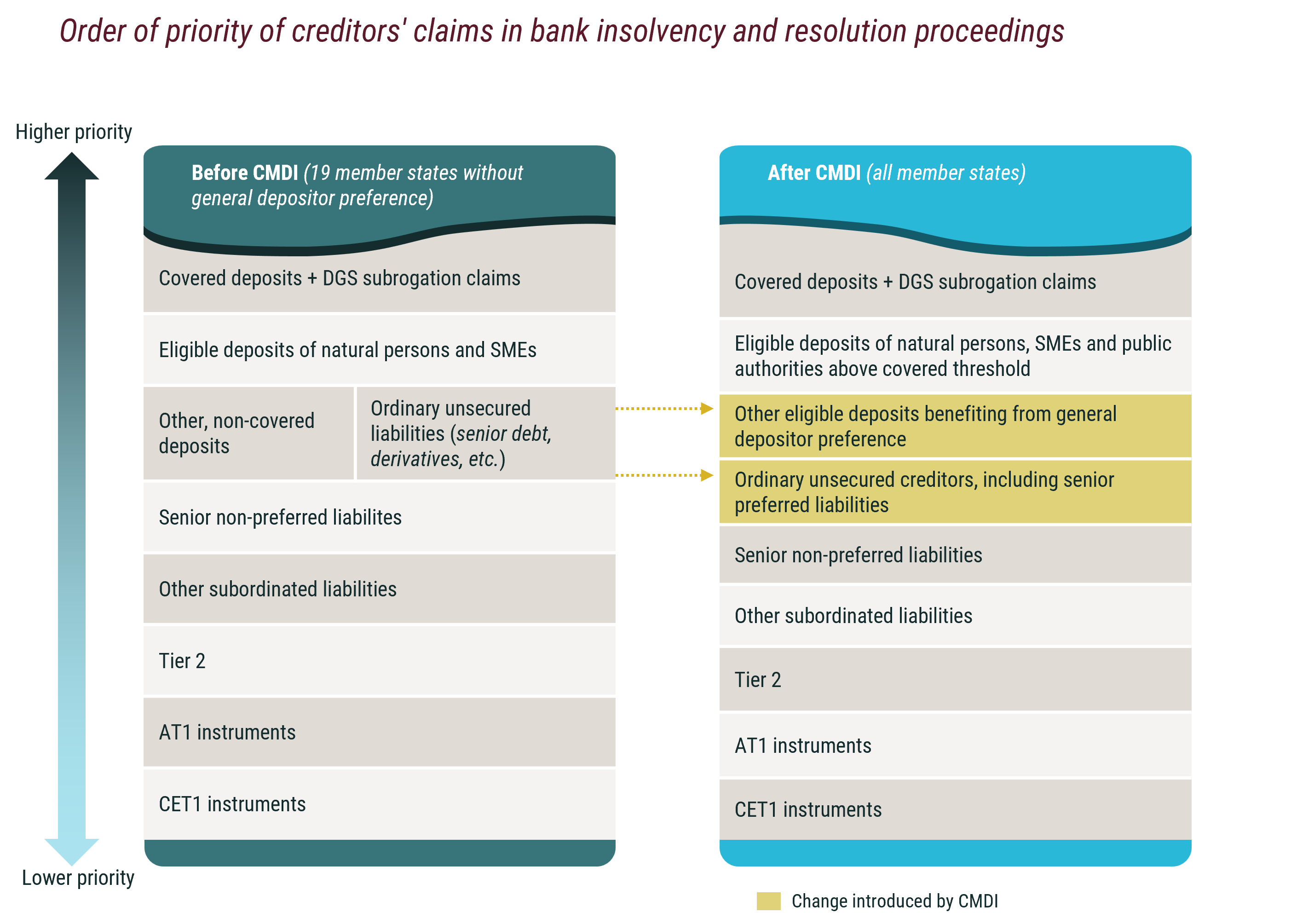
An important change in this area is the introduction of a general depositor preference across all EU member states. Under the amended Article 108 BRRD all deposits now rank higher than ordinary unsecured claims such as senior bonds in insolvency and resolution.
Extended coverage for public entities and client funds
Amended Articles 5 and 8b of the DGSD further broaden the range of protected depositors. Where previously excluded, local authorities, schools, hospitals and similar public bodies are now also covered for up to EUR 100,000. In addition – if the money is held in segregated accounts and the identities of the underlying clients can be established – money that payment institutions, e-money institutions and investment firms hold at a bank on behalf of their clients is now also protected for up to EUR 100,000 per end client.
Temporarily high balances
Amended Article 6 DGSD now harmonises the protection for temporarily large deposits across the EU at a minimum of EUR 500,000 for six months, replacing the different national rules that existed before. For money received from the sale of a private home the limit is EUR 2,500,000.
Exclusion from MREL
Simultaneously, where a bank wants to include deposits to count towards its MREL, more stringent conditions will apply. Pursuant to amended Article 45b BRRD, term deposits with a maturity of less than one year, or that grant the owner a right to early reimbursement, cannot count towards MREL. In addition, to ensure transparency towards deposit holders, deposits can only count towards MREL if this is explicitly disclosed to them in the relevant contractual documentation. Finally, if an institution wants deposits to count towards its MREL, it will need to obtain prior approval from the resolution authority.
Practical implications
The reforms affecting depositor protection and creditor hierarchy may have consequences for funding structures, documentation and DGS-related calculations. Financial institutions may therefore wish to consider the following practical implications:
- The change to the creditor hierarchy is likely to affect how large deposit-funded institutions model their bail-in waterfall, given that senior preferred bonds now rank below all deposits when losses are allocated.
- Contracts and issuance documentation prepared before the CMDI package becomes effective warrants review, as sections that described the general depositor preference as a proposal may no longer accurately reflect the legal position. The same applies to documentation for future bond issues.
- The impact of the new hierarchy on the rating of senior preferred debt is likely to be relevant to funding strategies and investor communications and can be assessed against the specific liability structure of the institution concerned.
- Institutions that receive deposits from public entities, payment institutions, or e-money institutions may find that the extended coverage affects their DGS contribution calculations.
- Institutions intending to count deposits towards their MREL may need to revisit the eligibility of those deposits, including the applicable maturity requirements, disclosure obligations and prior approval requirements.
Simplification and clarification
The EU's regulatory nature has gained renewed criticism amidst growing concerns of declining competitiveness, fragmented capital markets and relatively weak innovation capacity. Against this background, in combination with increasing geopolitical turmoil and economic instability, fostering competitiveness has become a key priority for policymakers.
The Letta Report on the single market and the Draghi Report on European competitiveness both argue that Europe must reduce unnecessary regulatory burdens, deepen market integration and enable firms to scale up and compete on a global scale. Following these recommendations, the EU devised the Competitiveness Compass, which seeks to strengthen Europe's innovation capacity, improve investment conditions and simplify the regulatory environment. The Digital and Sustainability Omnibus initiatives showcase this renewed approach, by seeking to simplify and proportionalise these frameworks.
In practice, the current resolution framework is not sufficiently resorted to, leading to excess usage of public funds when banks need to be rescued. Legal uncertainty and the complexity of the framework have been identified as key reasons for this issue. The CMDI package aims to sufficiently clarify, simplify and proportionalise the current framework to address these implementation problems.
New rules
Recovery and resolution planning
The package introduces several measures intended to reduce compliance burdens for smaller and less systemically important institutions by focusing recovery and resolution requirements on institutions whose resolution is not in the best interest of the public. A key change is the removal of the requirement to prepare a resolution plan for institutions that are classified as FOLTF, but whose resolution is not considered to be in the public interest. In this scenario, the institution is required to terminate its banking activities or exit the market through national insolvency proceedings, rather than to proceed with resolution in accordance with amended Articles 32 and 10(1) BRRD. Additionally, subsidiaries that decide to exit the market are also not subject to resolution planning requirements, taking into consideration their potential systemic importance and impact on available financial resources of the DGS in liquidation, in accordance with amended Article 12(1) BRRD. Finally, where no material changes have occurred within the last 12 months, the competent authority may waive the entity's obligation to update their recovery plan, pursuant to amended Article 5(2) BRRD.
Narrowing of contractual bail-in recognition
The CMDI package also narrows the scope of the contractual recognition of bail-in requirement with amended Article 55 BRRD. Contractual recognition refers to the inclusion of a clause in contracts not governed by EU law, with the counterparty recognising and agreeing that the claim in question may be written down, converted into equity or cancelled by an EU resolution authority where required in the context of resolution. The obligation is now limited to own funds instruments and bail-inable liabilities, excluding certain contracts relating to contingent liabilities. By reducing the range of contracts to be reviewed and amended, the framework expects to lessen operational and legal compliance burdens. Moreover, where third-country law achieves the same effect, member states may exempt the liability or instrument from the bail-in recognition requirement.
Clarifications on early intervention and prevention measures
Early intervention measures were initially introduced with the purpose of resolving the economic and financial deterioration of an entity and to reduce the risk and impact of a potential resolution. However, early intervention measures have been underutilised due to the legal complexity of their triggers and overlaps with other supervisory measures.
The review removes BRRD's early intervention measures that overlap with the prudential measures under the capital requirements regulation and investment firm directive. The package further lowers the threshold for applying early intervention measures, as it removes the requirement that other remedial actions must have already been taken, in accordance with amended Article 27(1) BRRD. Moreover, the replacement of senior management or the managing body and the appointment of temporary administrators, are now explicitly classified, and subject to the same triggers, as early intervention measures, in accordance with amended Articles 28 and 29 BRRD. Finally, the prior application of early intervention measures is no longer a prerequisite for the resolution authority to make marketing arrangements or request information to update the resolution plan, in accordance with amended Article 30a BRRD. As demonstrated by the SVB and Credit Suisse rescues, the sale of a troubled institution to another bank is likely to be at least one of the scenarios explored by resolution and supervisory authorities. Simplification of the legal framework in order to frontload such measures seems a very welcome amendment.
The SRMR implements similar simplification and clarification measures in amended Articles 13, 13a, 13b and 13c.
Practical implications
For banks, the CMDI package introduces various amendments aimed at reducing unnecessary resolution planning, reporting and compliance burdens for smaller and less systemically important institutions. Furthermore, it concentrates requirements on institutions whose failure is more likely to warrant resolution in the public interest, simplifying recovery and resolution planning while preserving financial stability objectives.
Key takeaways
The CMDI package marks a new era in bank recovery and resolution. The amendments aim to remove crisis management from its "legal straitjacket", in the words of Andrea Enria, by ensuring a full resolution toolkit and allowing for optionality in using it. While banks should carefully consider whether this requires amendments to their resolution plans, strategic focus should shift – as the regulatory framework is doing – towards operational readiness and strategic pragmatism.
A step that banks should add to their action list right away, is to conduct a review of relevant contractual frameworks and terms in their (especially senior) bond documentation, in view of amendments to the preferred position of eligible deposits. Smaller and medium-sized institutions should consider whether certain resolution tools that were previously not accessible could be especially helpful to them and consider implications for their resolution strategies.
experts

Marit van Zandvoort
Counsel

Mariska Enzerink
Partner

Eva Schram
Counsel
Emma Cramer
Associate

Ezinne Molenkamp
Legal Adviser